Why Do Property Prices in Croatia Keep Rising Even as Sales Fall?
On this page
- Sales are falling, but prices are not
- Croatia lacks new homes
- An average price does not tell you what property costs in your location
- The coast has its own property economy
- Foreign buyers are no longer looking only for a holiday apartment
- Transactions have fallen sharply in some coastal regions
- So why are prices not falling?
- Croatia is building less than the market needs
- Property as a hedge against inflation
- Croatia therefore has several property markets, not just one
- What will determine future price developments?
- Sources
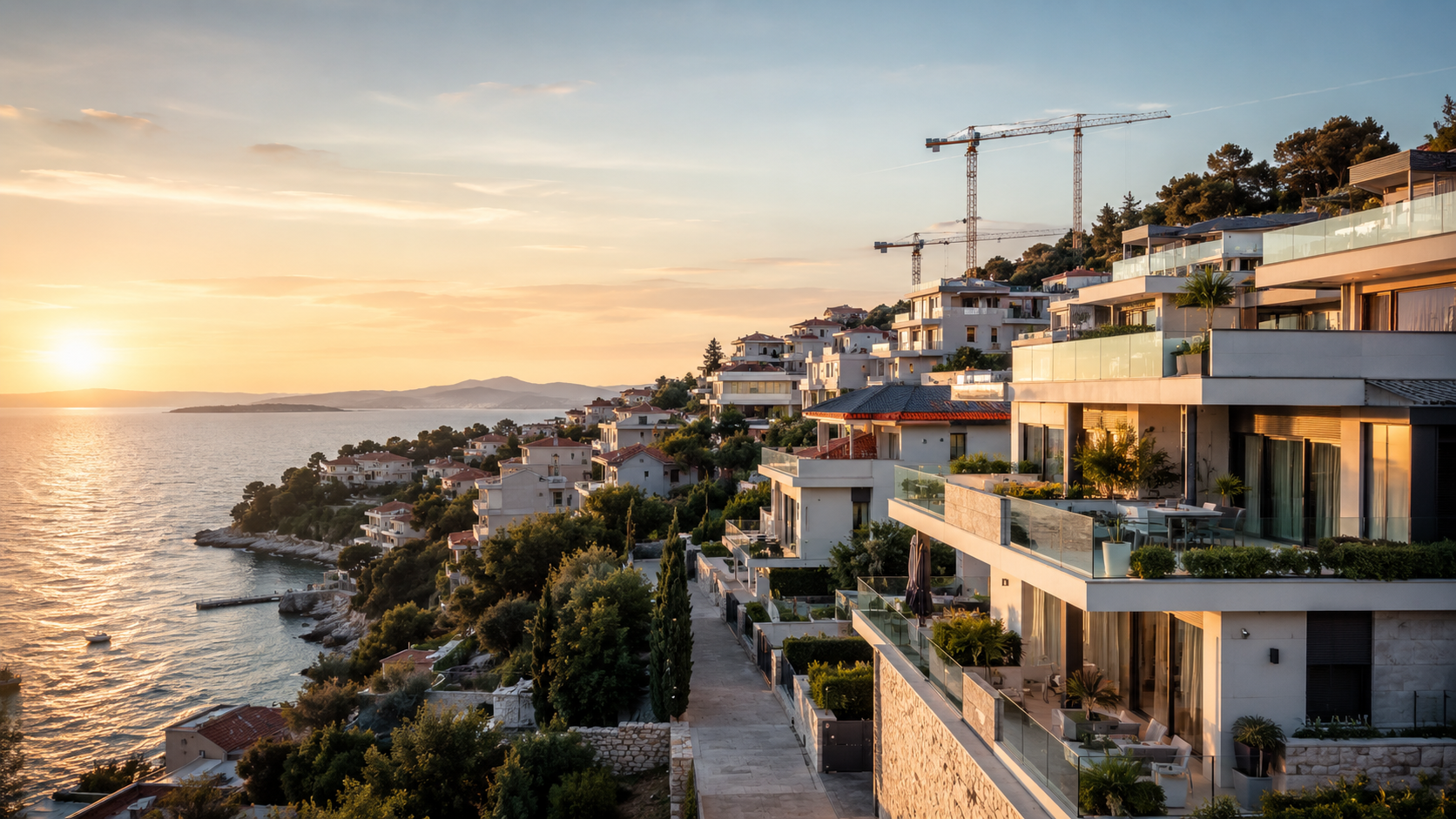
According to the Croatian Bureau of Statistics (DZS), residential property prices in Q4 2025 were 16.1% higher year on year. At the same time, HRT reported that roughly 10% fewer properties were sold in Croatia in 2025. This contrast captures the market’s apparent paradox: the number of completed property sales is falling, yet prices remain high and continue to rise in many locations.
Experts do not attribute this to any single factor, but to a combination of chronically limited supply, insufficient new construction, tourism, foreign demand and the investment appeal of Croatian property.
Lana Mihaljinec Knežević, a member of the Executive Board of the Real Estate Business Association at the Croatian Chamber of Economy (HGK), discussed current developments with Croatian public broadcaster HRT. Above all, she warned that nationwide averages can give a misleading impression of the Croatian market. Conditions in Zagreb, tourist centres on the coast and inland Croatia differ considerably.
Sales are falling, but prices are not
The number of completed property purchase transactions in Croatia has been declining for several years. According to Mihaljinec Knežević, this trend is particularly visible in the coastal counties, while Zagreb is also recording a more marked fall.
Different parts of the market also behave differently. Conditions for new builds are not the same as those for older flats, family houses or land. Geographical differences are equally important.
A decline in completed deals therefore does not automatically mean that prices must follow. One of the Croatian market’s main problems is not a lack of interested buyers, but above all a shortage of suitable properties for sale.
Croatia lacks new homes
According to the expert, insufficient supply is a long-term structural problem.
Mihaljinec Knežević points out that Croatia does not have enough newly built homes—not standard market homes, let alone affordable ones.
However, the problem is not confined to new construction.
A large proportion of the older housing stock was gradually sold in previous years, and many of the remaining properties are in a condition that does not meet today’s buyers’ expectations. These are often buildings that have seen little substantial investment for many years.
According to Mihaljinec Knežević, the situation is even more pronounced in areas with lower economic activity. The result is a market that may list a relatively large number of properties, while the supply of good-quality homes that buyers genuinely want remains limited.
An average price does not tell you what property costs in your location
When looking at Croatian prices, it is important to distinguish between individual regions.
The most expensive locations remain the well-known tourist centres on the coast. Examples cited by the expert include:
- Dubrovnik
- Rovinj
- Opatija
They are followed by Zagreb, while average prices are significantly lower in many parts of inland Croatia.
A nationwide average can therefore be only a very limited guide for a particular buyer. Differences between cities, regions and property categories are too great for a single average price to describe the entire Croatian market reliably.
The coast has its own property economy
One of the most important factors influencing property prices on the Adriatic remains tourism.
In some coastal locations, tourism is the dominant economic activity and the property market is very closely tied to it. This affects not only property prices, but also how the towns themselves function.
Tourist centres are extremely busy during the summer season, while economic and social activity can be substantially lower for the rest of the year. Much of the infrastructure and range of services is therefore geared specifically towards tourism.
Tourism also creates additional demand for property that does not come solely from people seeking a home of their own.
Foreign buyers are no longer looking only for a holiday apartment
Foreign buyers make up a significant group of purchasers on the Croatian coast.
According to Mihaljinec Knežević, their motivation is gradually changing. They are no longer buying only a conventional second home—a house or apartment used primarily for their own holidays.
Some foreign buyers now purchase or build property with the aim of offering it as tourist accommodation.
This means that local residents seeking a standard home are not competing only with one another. They share the same market with foreign buyers and investors whose purchasing power and financial calculations can be very different.
Economic developments in the countries from which foreign buyers come can therefore have a direct impact on the Croatian coast as well.
Transactions have fallen sharply in some coastal regions
According to the expert, the effect of changing foreign demand can already be seen in the number of completed deals.
More substantial declines in property purchase transactions have been recorded, for example, in:
- Split-Dalmatia County
- Šibenik-Knin County
- Primorje-Gorski Kotar County
Even this fall in sales has not yet automatically led to a more pronounced reduction in prices. The main reason is the limited supply already mentioned.
So why are prices not falling?
At first glance, it might seem that fewer buyers and fewer completed deals must sooner or later result in lower prices.
But the Croatian market is more complex.
According to Mihaljinec Knežević, this is a structural and highly complex problem that begins with spatial planning.
In many sought-after areas, there are not enough larger plots suitable for sizeable residential developments. At the same time, the necessary infrastructure is lacking and, outside Zagreb or the leading tourist centres, there are often too few jobs and services essential to young people’s everyday lives.
The result is a concentration of demand in a limited number of locations.
Where people genuinely want to live or invest, supply cannot respond quickly enough.
Croatia is building less than the market needs
Construction itself is another part of the problem.
According to the expert, Croatia has long failed to build enough new properties to meet existing demand. Yet the need for housing has not disappeared.
New households continue to form, young people move out of shared homes, families look for larger properties, and residents relocate for work or a better quality of life.
In the past, demand was also supported by certain government housing programmes.
When there is a lasting natural need for housing on one side and insufficient construction on the other, upward pressure on prices remains strong even if the total number of completed transactions is lower.
Property as a hedge against inflation
Croatian properties are not bought only as homes or holiday lets.
For many domestic and foreign investors, they are a way to preserve the value of their capital.
During periods of higher inflation, the incentive to move part of one’s savings into real assets grows. Property is traditionally viewed as one way to protect money from losing value over the long term.
This investment demand puts further pressure on limited supply and helps explain why prices remain high even as the total number of property transactions falls.
Croatia therefore has several property markets, not just one
Current developments show that assessing Croatian property solely by a nationwide average can be misleading.
In simplified terms, the market can be divided into at least several distinct segments: the Adriatic’s tourist centres, other coastal locations, Zagreb and its surroundings, and inland parts of the country.
Each of these segments responds differently to changes in domestic and foreign demand.
It is equally important to distinguish between new builds, older flats, houses and building land. A decline in transaction numbers in one part of the market does not therefore automatically mean a fall in prices in another.
What will determine future price developments?
The available information suggests that weaker sales numbers alone may not yet be enough to produce a significant reversal in the price trend.
The key factor remains supply.
Until enough new housing is built in sought-after locations, and while good-quality older properties remain scarce, the Croatian property market will have reason to keep prices relatively high.
On the coast, tourism and foreign capital add to this pressure; in large cities, it is the concentration of jobs and services; and across the market, there is also investment demand for property as a way to protect savings from inflation.
The current paradox of the Croatian market therefore has a fairly logical explanation: fewer properties may be selling, but if good-quality supply is even more limited and demand has not disappeared, prices do not have to fall.
Sources
- Croatian Bureau of Statistics: House Price Indices, Q4 2025
- HRT: Housing prices remain high, 17 February 2026
- Index.hr: Changes for home buyers, 6 July 2026
- MPGI/EIZ: Croatian Property Market Overview 2025
Current property listings
- Property in Zagreb 1,718
Found some inspiration? Browse current listings.
Filtered search by location, price and property type.Writes about Croatian real estate for CroReal.com.
Properties in Croatia are advertised 44% above official statistics. Where does the difference go?
Hotel Bellevue on Pag is for sale. The island's former pride awaits a new life
How CroReal is bringing AI to property listings: from translation to description analysis
Found some inspiration? Browse current listings.
Filtered search by location, price and property type.