Properties in Croatia are advertised 44% above official statistics. Where does the difference go?
On this page
- What does a 44% difference mean?
- How large is the usual discount in an actual sale?
- What do government statistics actually measure?
- And this brings us to a more sensitive question: does the amount in the contract always correspond to the total price actually paid?
- “Part in the contract, part cash in hand”
- And what happened to these suspicious prices?
- CroReal asked the Ministry for an explanation. We received no reply
- So are the official prices wrong?
- 44% is not proof. It is a very large question mark.
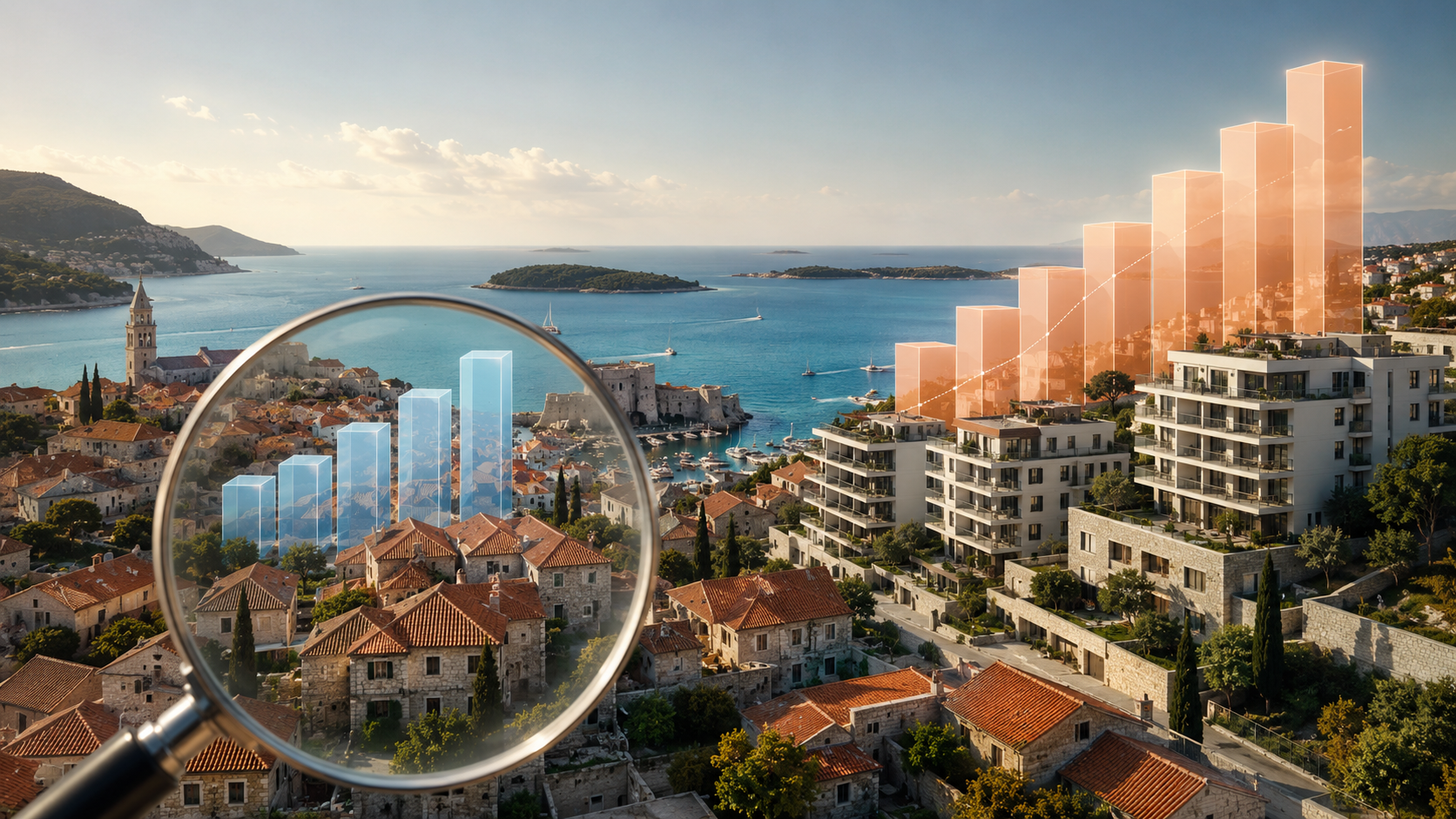
CroReal compared hundreds of thousands of data points on property asking prices in Croatia with official data on completed sale prices. The result is striking: asking prices in our dataset are approximately 44% higher on average. Ordinary negotiation undoubtedly explains part of the difference. But does it explain all of it?
When buyers search for a property in Croatia, they may encounter two completely different pictures of the market.
The first appears on property portals. These are the prices sellers currently ask.
The second is presented by official Croatian statistics based on completed transactions recorded by the state.
CroReal compared these two worlds using a very large dataset.
The result: asking prices are approximately 44% higher than prices derived from official data on completed transactions.
The difference is so substantial that, in our view, it is not enough simply to say: “Sellers give discounts.”
We need to ask what exactly is being compared, how government statistics are produced and whether the price recorded by the state always provides the best possible answer to how much a property really costs on the market.
What does a 44% difference mean?
First, an important mathematical note.
Imagine that, according to official completed-sale prices, a particular group of properties is worth:
€200,000
The corresponding asking value with a 44% difference would be:
€288,000
For a property advertised at €288,000 to sell for €200,000, its price would have to fall by approximately:
30.6% of the original asking price.
That is not the same as saying that “the buyer gets a 44% discount”, but it is still an exceptionally large difference.
One point must also be stressed: our comparison of large datasets does not mean that, for every individual property, we tracked the price of a specific listing and then the price of that same property in the purchase contract.
It is a comparison between the asking-price market and the completed-sales market.
And this is where the situation starts to become interesting.
How large is the usual discount in an actual sale?
Data from the Croatian market show that the result depends heavily on methodology.
An analysis by Opereta cited by HINA, for example, reported a difference of only approximately 4% between asking and completed-sale prices for older flats sold in Zagreb in the first half of 2025. An analysis covering the whole of 2025 later reported approximately 5.4%.
By contrast, an academic analysis of the Zagreb market based on a combination of different data sources found substantially larger differences; a publicly available comparison gave an average asking price of €3,256/m² versus a completed-sale price of €2,348/m², a difference of almost 39%.
This is crucial.
The difference between asking and completed-sale prices is not automatically the same as the discount negotiated by a particular buyer.
Aggregated statistics are also affected by differences in the composition of properties, location, the period of sale, property condition, the representation of new builds and older properties, and the fact that some overpriced listings never sell.
Nevertheless, the question remains:
Why is the gap in large aggregated datasets so enormous?
What do government statistics actually measure?
The Croatian eNekretnine information system contains the Zbirka kupoprodajnih cijena, a database of completed transactions.
The Ministry states that this is a record of the completed market based on information from sale documents and subsequent data evaluation. The statutory system also provides for data on completed property transfers for consideration to be taken from the records of the Croatian Tax Administration, the Porezna uprava.
The Ministry also uses these data for its annual publication Pregled tržišta nekretnina Republike Hrvatske.
The Ministry itself says that one of the publication’s main purposes is to increase property-market transparency and give the public an overview of the market’s condition and development.
That is a legitimate and highly useful purpose.
The problem arises when consumers begin to read these figures as an answer to a different question:
“How much will I realistically pay for a property in this location today?”
Official statistics may not give the same answer to this question as the current market.
And this brings us to a more sensitive question: does the amount in the contract always correspond to the total price actually paid?
We are not claiming that the 44% gap represents untaxed money.
Our data do not support such a conclusion.
There is, however, a reason why the question cannot simply be dismissed.
In Croatia, for transactions not subject to VAT, property transfer tax amounts to 3% of the property’s market value.
More importantly, another part of the rules provides that if the Porezna uprava finds that the value stated for the transfer does not correspond to market value, it may determine the market value by estimation. The law also defines the total consideration broadly—as everything the acquirer provides or pays to obtain the property.
The Croatian legal system therefore expressly anticipates the possibility that the declared value may not correspond to the market.
But this is not yet the most interesting part.
“Part in the contract, part cash in hand”
During our research, we came across a particularly interesting official document.
It is not an online discussion, an estate agent’s comment or CroReal’s opinion.
It is the Izvješće o tržištu nekretnina Sisačko-moslavačke županije za 2022. godinu.
In it, the authority describes cases of unrealistically low purchase prices, especially for land. Some contracts recorded amounts far below the level officials considered a realistic market price.
The document then raises the possibility that the properties were not in fact sold so cheaply, but that:
part of the amount was stated in the contract and the other part was paid “na ruke”, or cash in hand, in order to reduce the tax liability.
The document’s authors correctly add that this is only an assumption.
That is important to emphasise.
This document does not prove that a significant proportion of Croatian flats and houses are sold in the same way.
It does, however, demonstrate something else:
While processing real purchase contracts, the Croatian public administration itself encountered prices so low that it expressly cited the omission of the full amount paid from the contract for tax reasons as one possible explanation.
And what happened to these suspicious prices?
This is where the story becomes even more interesting.
Sisak-Moslavina County states that unusually low transactions were moved to the category “neuobičajene ili osobne okolnosti”, meaning unusual or personal circumstances.
Why?
According to the document itself, leaving them in the standard data would have significantly lowered the realistic picture of average market prices.
In other words, officials found prices they did not regard as credible in the context of the ordinary market and separated them during evaluation.
From a methodological perspective, that is understandable.
However, some unrealistically high prices were also separated from the ordinary market in a similar way, including transactions related to the expropriation of land for infrastructure projects.
It is therefore not possible to claim automatically:
“If the state put all excluded transactions back, the 44% gap would be even larger.”
It might be larger. It might also be smaller.
Without detailed data on the number and value of excluded transactions, we do not know.
Those are precisely the data about which we wanted to ask the Ministry.
CroReal asked the Ministry for an explanation. We received no reply
Before publishing this article, we contacted the Ministarstvo prostornoga uređenja, graditeljstva i državne imovine, Croatia’s Ministry of Physical Planning, Construction and State Assets, and gave it an opportunity to comment on the results of our analysis.
We described the identified gap of approximately 44% to the Ministry and asked several specific questions.
We wanted to know:
- How many transactions each year receive the status “neuobičajene ili osobne okolnosti” in the eNekretnine system, and how many of them concern unusually low rather than unusually high prices.
- Whether these transactions are included in statistics published in the Pregled tržišta nekretnina Republike Hrvatske.
- How the state verifies whether the amount stated in a purchase contract corresponds to the total amount actually paid for the property.
- How many transactions the Porezna uprava revalues because the declared value does not correspond to the established market value.
- Whether the Ministry has ever systematically compared completed-sale prices from eNekretnine with publicly advertised asking prices.
- How the Ministry explains the gap, which reaches approximately 44% in CroReal’s large-scale data comparison.
By the editorial deadline for this article on 2 September 2026, we had not received a response from the Ministry.
The absence of a response is, of course, not evidence that the statistics are incorrect or that any unlawful conduct has occurred.
It does mean, however, that questions which we consider crucial to the correct interpretation of government price data remain unanswered.
If the Ministry replies at a later date, CroReal will add its position to the article.
So are the official prices wrong?
That would be far too simple a claim.
The official eNekretnine database is an exceptionally valuable source of information. It contains actual recorded transactions and makes it possible to track long-term market development in a way that a property portal containing asking prices cannot do on its own.
But “the completed-sale price recorded by the state” and “the property’s current market price” are not automatically the same thing.
The first is historical information about a particular set of completed and subsequently evaluated transactions.
The second is the amount for which a specific property can actually be bought today under specific conditions.
And the difference between them can be substantial.
If, for example, government statistics show a price of €2,000/m² while comparable current properties are advertised on the market at around €2,800 or €3,000/m², it is not particularly useful to tell a buyer simply:
“The real price is €2,000/m² because the state says so.”
Our data show precisely why reality is more complex.
44% is not proof. It is a very large question mark.
CroReal’s result does not say that Croatian sellers routinely receive part of the price in cash outside the contract.
Nor does it say that the Ministry’s data are false.
And it does not say that every buyer can negotiate more than 30% off the asking price.
It says something else:
In our large-scale comparison, there is an exceptionally large gap—approximately 44%—between the prices at which Croatian properties are publicly advertised and the prices shown in official transaction data.
Negotiation explains part of it.
Differences in the composition of advertised and actually sold properties may explain another part.
Another part may be caused by time lags and statistical methodology.
At the same time, official Croatian documents confirm that the public administration has encountered contract prices so suspiciously low that it itself cited payment of part of the purchase price outside the contract as a possible explanation.
We do not currently know how much of the resulting 44% is attributable to each of these factors.
That is precisely why we expected a response from the Ministry.
We did not receive one.
Until there is a convincing explanation for this difference, we consider it misleading to present the official completed-sale price alone as a simple answer to the question:
How much does a property in Croatia really cost?
CroReal will therefore continue to monitor asking prices and official completed-sale prices separately.
Because the difference between them may be one of the most interesting pieces of information about the Croatian property market.
Current asking prices by location and property type can be found in CroReal’s property price statistics.
Current property listings
- Property in Zagreb 1,719
Found some inspiration? Browse current listings.
Filtered search by location, price and property type.Writes about Croatian real estate for CroReal.com.

Why Do Property Prices in Croatia Keep Rising Even as Sales Fall?
Hotel Bellevue on Pag is for sale. The island's former pride awaits a new life

How CroReal is bringing AI to property listings: from translation to description analysis
Found some inspiration? Browse current listings.
Filtered search by location, price and property type.