Drinking water on Pag and Rab: current tests confirm it is safe
On this page
- Current conclusion: tests show the public water supply is safe
- Why concerns arose about the water on Pag and Rab
- 11 August test: PFAS in raw water from Hrmotine were below the quantification limit
- 13 August sampling: 22 taps and one reservoir on Rab
- One sample containing lead did not indicate a problem with the public network
- Which towns and municipalities are covered
- What the results mean for property owners and visitors
- The conclusion does not automatically apply to wells, cisterns or internal plumbing
- Status as of 22 August 2026: monitoring continues
- Sources
Extraordinary sampling carried out on 11 and 13 August 2026 found no evidence of contamination in the public drinking-water supply on Pag, Rab or in Novalja. PFAS were below the limit of quantification in every sample analysed; 21 of the 22 tap-water samples complied with the prescribed limits, while the sole lead-related deviation was linked to the internal plumbing of a private property.
This conclusion applies to water supplied by the public water system and summarises the information available as of 22 August 2026. It does not mean that the investigation into the environmental case in Lika has ended, nor can the same results automatically be applied to private wells, cisterns or the plumbing systems of individual buildings.
Current conclusion: tests show the public water supply is safe
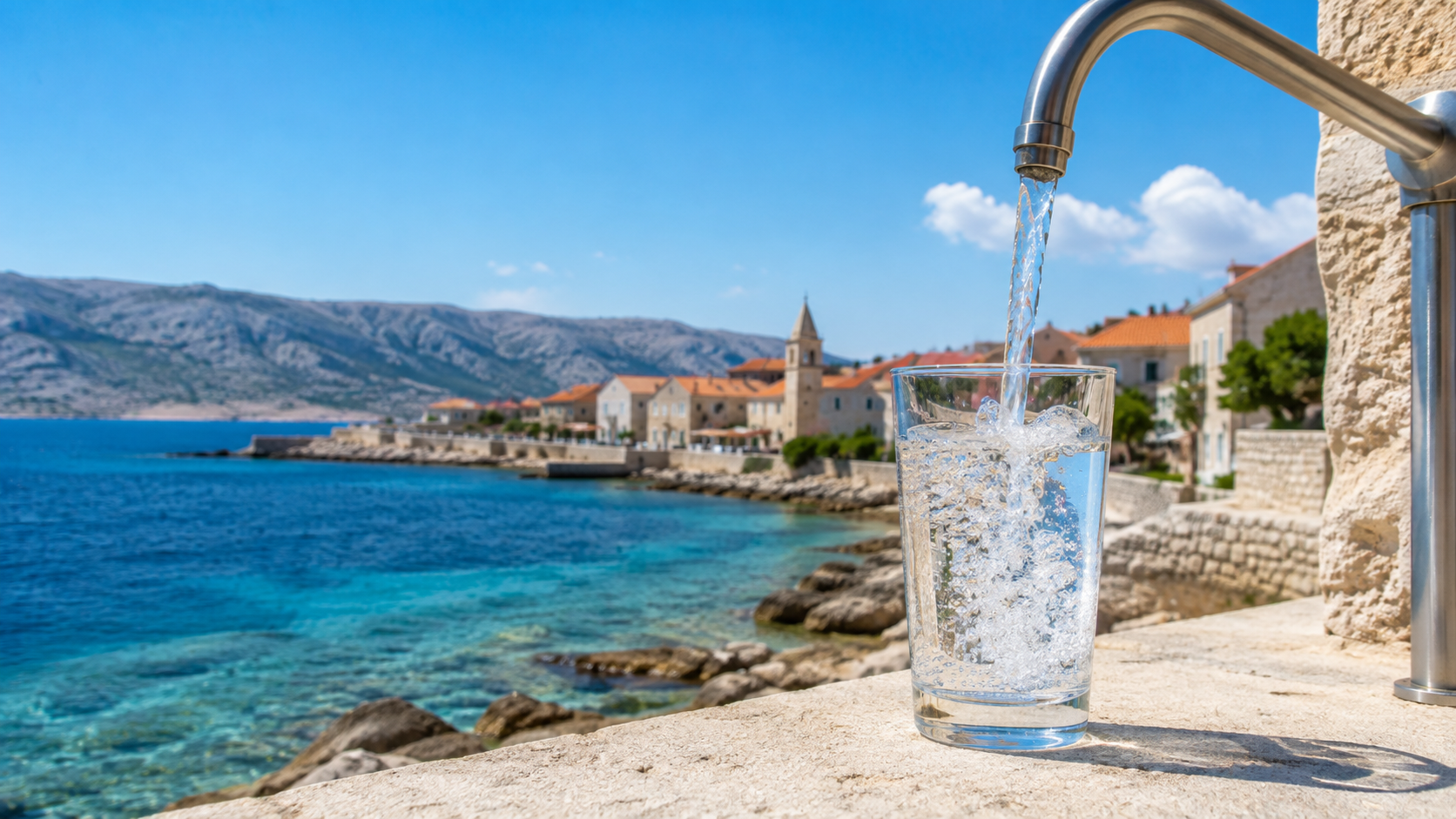
According to official notices from the City of Pag, the City of Novalja, Vodovod Hrvatsko primorje, the Croatian Institute of Public Health (HZJZ) and the Croatian Ministry of Health, the water supplied through the public network in the affected supply area is safe and fit to drink.
The extraordinary analyses conducted so far have not found the monitored PFAS substances at concentrations that the laboratory could reliably quantify. In the samples taken, the values for each PFAS analysed were below the limit of quantification of 0.0015 µg/l.
On the basis of the current evidence, residents, property owners and visitors therefore face no restriction on the normal use of water from the public supply. The wording “on the basis of the current results” is important, however: monitoring is continuing, and any newer instructions issued by health authorities, the water supplier or local authorities should always take precedence.
Why concerns arose about the water on Pag and Rab
In August 2026, reports about illegally deposited hazardous waste near Gospić in the Lika region and the possible impact of the dump on local groundwater attracted considerable attention. The substances being monitored include PFAS, often called “forever chemicals” because they break down only very slowly in the environment.
Concern was heightened by the karst geology, where groundwater can move through complex systems of fissures and cavities. The public therefore legitimately called for checks on the sources and water-supply networks serving part of the coast and the islands of Pag and Rab.
Two issues must nevertheless be kept separate. The illegally deposited waste and its possible local effects are a serious problem requiring remediation and long-term oversight. On their own, however, they are not proof that treated water delivered to consumers through the public supply has been contaminated. That second question is precisely what both routine and extraordinary sampling examined.
11 August test: PFAS in raw water from Hrmotine were below the quantification limit
During extraordinary sampling on 11 August, HZJZ collected three raw-water samples and three samples of water at the point of use in Lika-Senj County. In the samples analysed, the concentrations of all 20 monitored PFAS compounds, as well as their sum, were below the limit of quantification of 0.0015 µg/l for each substance.
The Hrmotine water intake was among the sampling points. This was a sample of raw water that had not yet been treated. The precise conclusion is therefore that the monitored PFAS were below the limit of quantification in that sample. The result cannot be extended into a general claim that untreated raw water from the source is directly fit to drink or that its microbiological quality was independently confirmed by this test.
Water from the sources undergoes the prescribed treatment and disinfection before distribution. For consumers, what matters is the quality of the water delivered through the public network at the point of use, not whether untreated raw water at the source itself is drinkable.
13 August sampling: 22 taps and one reservoir on Rab
The second round of extraordinary sampling took place on 13 August and was broader in scope. HZJZ collected 22 samples of water intended for human consumption directly at points of use, meaning taps inside properties, as well as one sample from a reservoir on the island of Rab.
In all these samples, the PFAS analysed were below the limit of quantification of 0.0015 µg/l for each compound. “Below the limit of quantification” does not mean mathematical zero. It means that any concentration below that threshold cannot be measured by the laboratory method used with the required accuracy.
Of the 22 samples collected from taps, 21 were assessed as meeting the prescribed limits. One sample failed because of an elevated lead concentration. This deviation did not concern PFAS and, according to HZJZ's explanation, did not indicate a problem with the public water network.
One sample containing lead did not indicate a problem with the public network
The elevated amount of lead was measured at a tap in one private property. HZJZ linked the result to that building's internal plumbing, not to the water supplied by the public provider.
No elevated lead concentrations were found in water distributed from the Hrmotine intake or at the other monitored locations in the same supply zones. The single non-compliant sample therefore cannot be interpreted as contamination of the entire public network.
In connection with such a finding, HZJZ recommended regularly flushing internal plumbing, especially after outlets have not been used for a longer period, and then carrying out follow-up sampling. For property owners, this is a reminder that the material, age and condition of pipes inside a building can also affect water quality at a particular tap.
Which towns and municipalities are covered
In a notice published by the City of Novalja on 17 August, Vodovod Hrvatsko primorje stated that water intended for human consumption was safe throughout service area No. 28. The area includes:
- the town of Pag,
- the town of Novalja,
- the town of Rab,
- the town of Senj,
- the municipality of Kolan,
- the municipality of Povljana,
- the municipality of Lopar,
- the municipality of Karlobag.
The supplier's notice is based on ongoing laboratory checks and, following the strengthening of oversight, more frequent sampling. On 12 August, the City of Pag had already reported that PFAS had been monitored there since 2025, before the legal requirement came into force, and that the analyses conducted to date had not detected their presence.
What the results mean for property owners and visitors
According to the information available as of 22 August 2026, water from the public supply in the specified service area can be used normally for drinking, food preparation, cooking, personal hygiene and the everyday operation of homes or accommodation facilities.
No general restriction has been published requiring residents or tourists to avoid drinking water from the public network or to treat it specially before use. Owners of apartments and houses should, however, distinguish between the condition of the public network and the plumbing within their own building, particularly in older properties or those left unused for a long time.
If a local warning is issued, the water changes unusually or there are concerns about a specific installation, the current instructions of the water supplier or the competent public-health institute should be followed. An older online article cannot replace a new notice issued for a particular location.
The conclusion does not automatically apply to wells, cisterns or internal plumbing
The results described in this article concern the monitored sources, the public water network and the specific samples collected. They cannot automatically be used as proof that every private well, cistern or other local source outside the controlled system is safe.
A building's internal installations also play a separate role. Even when the supplier delivers compliant water to a property, its characteristics at the tap can be affected by old pipes, fittings, prolonged stagnation or a poorly maintained storage tank. The lead finding in a single private property illustrates why this distinction matters.
For individual sources or when a problem with a building's plumbing is suspected, a laboratory analysis of the specific water and the advice of the competent specialist institution are decisive, not a result from another sampling point.
Status as of 22 August 2026: monitoring continues
On 20 August, the Croatian Ministry of Health stated that all samples of water intended for human consumption analysed to date had been safe, that PFAS had not been detected above the relevant limit of quantification and that monitoring would be expanded further.
This is reassuring news for the public water supply on Pag, Rab, in Novalja and in other parts of the service area. At the same time, the environmental case near Gospić remains serious. The safety of the drinking water currently being supplied and the need to remove illegally deposited waste are related but distinct issues.
This article summarises the situation as of 22 August 2026 and applies to the public water supply. It does not replace newer instructions from HZJZ, the Ministry of Health, the water supplier or local authorities, and it cannot automatically be applied to private wells, cisterns or the internal plumbing of a particular property.
Sources
- HZJZ: results of extraordinary sampling from 11 August 2026
- HZJZ: results of extraordinary sampling from 13 August 2026
- City of Pag: notice to residents dated 12 August 2026
- City of Novalja and Vodovod Hrvatsko primorje: water quality in service area No. 28
- Croatian Ministry of Health: current situation and continuing monitoring
Current property listings
Found some inspiration? Browse current listings.
Filtered search by location, price and property type.Writes about Croatian real estate for CroReal.com.
Hotel Bellevue on Pag is for sale. The island's former pride awaits a new life
Payments in Croatia: what HR01, HR03 and other models mean

Bačić: preventing real estate business disguised as tourism
Found some inspiration? Browse current listings.
Filtered search by location, price and property type.