House Zlatar
For sale · Zlatar · Krapinsko-zagorska


Property description
House 218m² with auxiliary facilities in a quiet place near Zlatar
House for sale with auxiliary buildings near the town of Zlatar.
Located in a quiet and tame village of Donja Batina, the house guarantees silence and rest.
Perfect for families looking for harmony between nature, birds chirping and proximity to all important amenities.
The house includes on the ground floor lobby, hallway, bathroom, bedroom, study, living room and kitchen with dining table - perfect for family gatherings, boiler room and IZBU - ideal for organizing your things.
Attractively designed stairs move to the floor, which includes the main bathroom, three spacious bedrooms, a balcony (north orientation) and a terrace (west orientation).
The attic is in RohBau condition, and is currently used as an additional storage.
The special feature of this house are auxiliary buildings, built-in ground floor in a area of approximately 80m2 and a garage, and the location of the property - the access is made by a side road along the forest.
The house is for sale furnished and fully functional, and is immediately habitable.
Heating is carried out centrally using a combined gas boiler, with an installed furnace on the log - oil (with the possibility of conversion to wood) as an alternative source of heating.
Electricity, water, gas and septic tank connected to the facility.
4km from the town of Zlatar; shops, schools, kindergarten, playgrounds, banks, parks, post office..
Everything at hand.
Position of the house:
Marija Bistrica; 15km (19 min drive)
Zabok; 26km or 26 min by car
Varaždin; 41 km or 50 min drive
Krapina; 28 km or 35 min easy ride
Zagreb; 39 km or 48 minutes by car
The land of predominantly irregular shape L of 1.601m2 measures 41 meters in width and 35 meters in length on average.
The documentation exists, and it includes a deed, a building permit from 1974.
year, a valid license from 2017.
years for the house, as well as an energy certificate.
The supporting buildings are not covered by the above documentation.
The town of Zlatar; as the oldest known data with the name of the place is mentioned the property Zlatharia within the family Bedeković from the end of 13.
century.
Zlatharia is the Latin form of the Croatian word Zlatar.
But the original form of the name of today's Zlatar, as it was pronounced by the people who lived there at the time, was Zlatarjevo or Zlatarjevo.
There are several assumptions about the origin of the word "gold" in the name of the name.
According to one, this gold was extracted in the ancient past from streams flowing from Ivanščica through the goldsmith's area.
According to the second of the names of the feudal family Aranjoš (arany means gold) that ruled this area in the 16th century.
The third assumption is related to the treasure that the Turks supposedly buried in the Zlatarsko polje in the area that is still called "Gradine" today, which is left in the memory of the people of some buildings that are not known today, but have existed in the past.
The property "Zlathari" is mentioned by lists and tax returns in Croatia in 15.
and 16.
the Institute for Croatian History 1976
in the possession of the estate "Ostertz" as a possession "domini Ludovici" 1533.
of 1543.
and 1544.
as the property of Juraj Poljičanin.
In 1566.
"possessio Zlatar" belongs to the family Aranyassy and here the name Zlatar is mentioned in its present form.
Over a period of 10.
to 14.
For centuries there has been a great deal of uncertainty as a result of which cities were built with fortified thick walls on hard-to-reach highlands.
On the slopes of Ivanščica there were: Stari Lobor, Oštrc, Belec, Melem and Greben, and under them the oldest church parishes in Lobor, Martinščina, Belec and Zajeda.
The parish of Belec was mentioned as early as 1242, the parish of Hraina, Mihovljan, Lobor and Oštrc (based in Martinsk) 1334.
In the year 1336, the parish of Zazeda.
years.
Only at the end of 17.
and at 18.
centuries revive the plains where the hills end and the roads cease to be sources of fear and the importance of the area of goldsmith's property begins to grow.
Proof of this is the actual holding of fairs which is 25.
June 1659.
in the year King Leopold awarded Zlatar at the request of Count Peter Keglevic.
>>bos_Latn<< The fair is also mentioned in 1433.
In the year when the fair right from King Matthias Corvinus received the Borkovets ruler Grgur Fodroczy.
In 1699.
the center of the church parish from Martinščina was transferred to Zlatar where it is 1762.
A new church was built.
During this period, feudal lords began to build new, comfortable residential buildings and several curiae appeared in Zlatar itself and the wider area of Zlatar, in Lobor (now a home for adults), in Borkovac (Mihanocić), in Ladislavc (Neudorfer).
In Zlatar, the roads that connect Zagreb and Varaždin cross, bypassing Ivanščica and Medvednica, which gives Zlatar an advantage.
One bypasses Medvednica from the east through Kašina, through Zlatar and Golubovec and the northern side of Ivanščica towards Varaždin, while the other bypasses Medvednica from the western side at Podsused and leads through Zlatar and Belac from the eastern side of Ivanščica towards Varaždin.
At 19.
For a century, Zlatar has fully established itself as the administrative, political, economic and cultural center of the entire region.
In 1842.
The history of the goldsmith’s primary school, which is closely connected with the history of the parish, begins.
>>bos_Latn<< Priest Ivan Gundak started the school in 1666.
the year of purchase of the land on which the teacher's house was built.
In 1862.
A new school was built.
The school was the most beautiful in the Croatian Zagorje at that time, and today it houses the Zlatar City Library.
After the Austro-Hungarian Settlement (1867) and the Hungarian-Croatian Settlement (1868), and especially during the banning of Ivan Mažuranić, Zlatar became a municipal and Kotar seat, and it experienced its largest administrative promotion in 1875.
in the year when it became the center of the sub-county whose status later lost (1886), but still remains the center of Kotar.
1873.
The first reading room was founded in Zlatar, which had about seventy members, and uro Rukavina was elected as the first president.
1907.
A telephone has also been introduced in Zlatar for years.
Many societies and associations were founded, a branch of the Croatian Falcon, a cycling club "Lastavica" as well as a singing and tamburitza choir.
In the same year, two weekly newspapers began to be published: the Pravaški list "Croatia with Croatia" and the coalition "Zlatarski weekly".
The gathering of winegrowers who worked in the entire area from Zelina through Zlatar to Ivanac is encouraged.
At the time, in 1877.
Goldsmith also received a Volunteer Fire Society and 1883.
year of hunting.
There is an enrichment of public and social life with the construction of the “thumping room” of the Croatian Falcon, which was built by the parish priest Dr. Bistrica.
>>bos_Latn<< Juraj Žerjavić 1910.
years.
A year later, the building of the Girls' School in Zlatar was built.
>>bos_Latn<< The property is 1/3 neat, with no cargo.
Are you interested in seeing this interesting opportunity to buy a house in one of the most peaceful parts of the Croatian Zagorje?
Feel free to contact me to allow you to investigate it personally.
PriceCheck
There are not enough comparable listings for this property yet.
Additional Details
- Price
- 60,000 €
- Status
- For sale
- Category
- House
- Position
- Zlatar
- District
- Zlatar
- County
- Krapinsko-zagorska
- ZIP
- 49250
- Living Area
- 218 m²
- Land size
- 1,601 m²
- Rooms
- 6
- Bathrooms
- 4
- Garage
- 1
- Listing ID
- 275038
What our AI found in the description
- Balcony
- Furnished
- Garage
- Terrace
These features were automatically detected by AI from the listing description. They may not be fully accurate and have not been verified by the agency.
Frequently asked questions about this property
How much does this property cost?
Price: 60,000 € · Price per m²: 275 €/m²
How big is this property?
Living Area: 218 m² · Land size: 1,601 m²
How many rooms and bathrooms does the property have?
Rooms: 6 · Bathrooms: 4
Show on the map
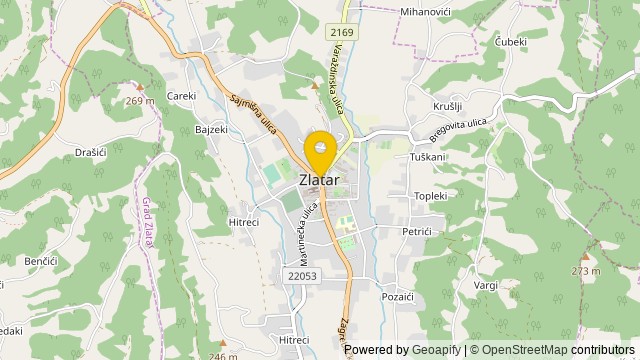 Show on the map
About the area: Zlatar, Croatia
Zlatar is a town and municipality in Krapina-Zagorje County in Croatia.
Population: 5 574
Source: Wikipedia


